
The FSCA's register of over-the-counter derivative providers
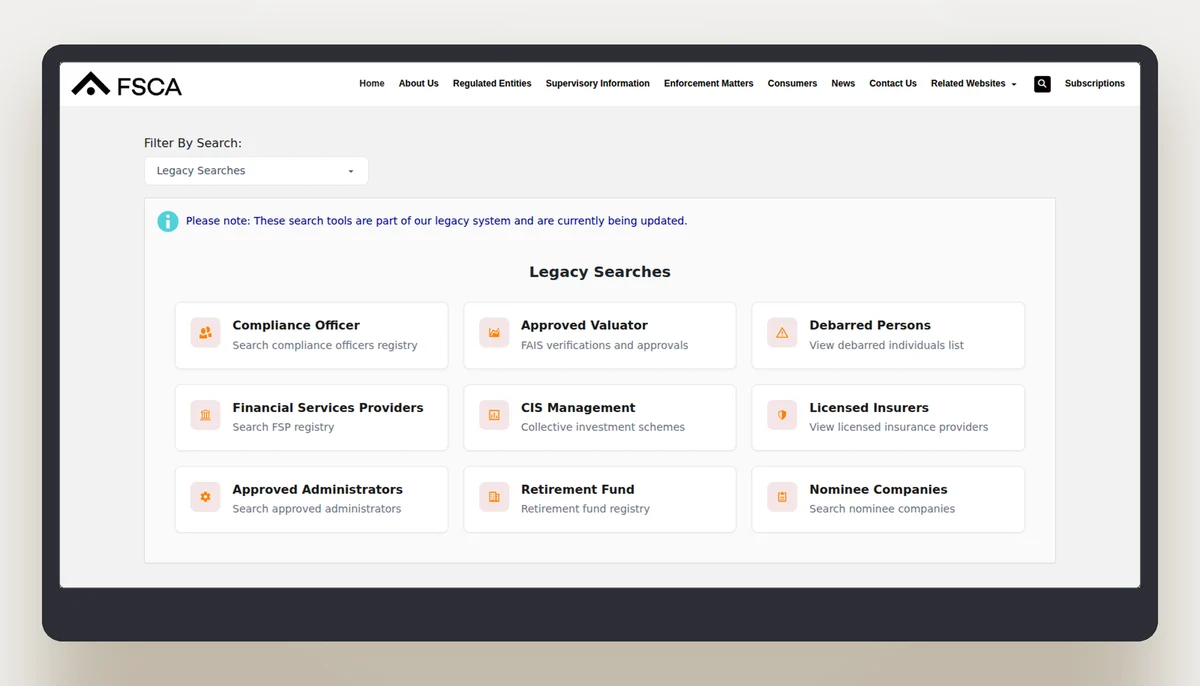
The FSCA keeps a register of over-the-counter derivative providers, the category most CFD brokers fall into. This page explains what the register shows, what each status means, and how to read the live table.
What the register is
The register of over-the-counter derivative providers is a list the FSCA publishes of firms that hold, have applied for, or have had a licence to offer over-the-counter derivatives. Most CFD brokers fall into this category, because a CFD is an over-the-counter derivative. The register shows the legal name of the provider, the date the source published it, the status the register shows, and a link to the original.
The register is a public record. Anyone can read it on the FSCA's website. It is the authoritative list of providers in this category. This site's table is read from the register once a week, and each row carries the date the source published it or the status date the register gives.
The live table and its columns
Above this text sits a live table of the derivative-provider register. Each column is a field the register shows: the name exactly as the source wrote it, the date the source published it, the status the register shows, and a link to the original. The table quotes no figure and names no entity in prose. A row records what the source published, not a finding of ours.
The reader can sort the table by name, date, or status. The status is the register's own word, and it can change. The register does not give reasons for a status. The original register on the FSCA's site is the authoritative record; this table is a convenience.
What each status means
The register uses six status words. Authorised means the provider holds a licence for over-the-counter derivatives at the time of the read. Application pending means the provider has applied and the regulator has not yet decided. Application withdrawn means the provider pulled its application. Application refused means the regulator declined it. Exempt means the provider is exempt from holding a licence under the current rules. Licence ended means a licence the provider once held has come to an end.
A status is a snapshot. A provider can move from one status to another, and the register does not say why the status changed. When a reader checks a platform, the exact legal name matters: the register lists entities by their legal name, and a trading name alone is not enough.
Why the status matters
The status tells the reader what the FSCA's register says about the provider at the time of the read. If a platform claims to be authorised, the reader should look for the word authorised in the register. If the register shows another status, the platform's claim does not match the register. The register does not give reasons for a status, so the reader should not guess why a status is what it is.
The status is the register's word, not this site's. This site does not interpret why a status is what it is. The reader should read the status as a fact: the FSCA has recorded this word for this provider. The reader can then decide what to do with that fact.
How to compare a platform with the register
To compare a platform with the register, the reader needs the exact legal name the platform shows and the FSP number if it shows one. The register lists providers by legal name, so the reader should search for that name. If the platform shows a different name, the reader should ask why. The reader should also compare the contact details and the website with the register entry.
The register may not show the trading name the platform uses. A platform can trade under a name that is not its legal name. The reader should ask for the legal name and the FSP number, and search those. If the platform does not give a legal name or an FSP number, that is a warning sign.
What the register does not show
The register does not show how the provider treats clients, how it prices, or whether it will return money. A provider can be authorised and still act badly. The register does not show the provider's financial health, and it does not show whether the provider has been the subject of complaints. The register is a list of licences, not a rating of providers.
The register also does not show the full history of a provider's status changes. A provider can move from authorised to licence ended and back, and the register does not say why. The reader should use the register as one check among several, not as the only check.
A provider can be on the register while its licence application is still being assessed
The FSCA uses the register to show every application it has accepted for assessment, not only the applications it has approved. A provider with a pending status has submitted papers and paid the fee, but the regulator has not yet made a decision. The entry appears because the FSCA has a duty to publish what it is working on.
This pending window is a real period of uncertainty for a client. The provider is not yet authorised to act as an OTC derivative provider, and the FSCA has not said it will be. Some platforms treat a pending entry as if it were a licence. It is not.
The FSCA can take months to move a pending application to authorised or refused. During that time the provider may be operating under another licence category or not at all. The register does not explain the delay, and it does not promise that approval will follow.
A provider can be removed from the register without ever being refused
An entry that vanishes from the register is just as important as an entry that appears. The FSCA removes providers when a licence lapses, when a provider asks to withdraw, or when the regulator withdraws the licence itself. The register does not keep a public history of removed names.
A platform that was listed last month and is missing today has changed its regulatory position. The FSCA does not publish a separate list of removed providers, so the only way to notice the removal is to check the register regularly. A bookmark to an old entry will not help.
Removal is not the same as refusal. A refusal is a decision on an application; a removal can happen after years of authorised status. The register does not say why the provider left, only that it is no longer there.
The register does not list every firm that offers OTC derivatives to South Africans
The register is a list of providers the FSCA knows about and has processed in some way. It does not claim to be a complete census of every platform that offers contracts for difference or similar products to South African residents. A platform that has never applied and has never been warned will not appear.
Some platforms deliberately stay out of the FSCA's sight. They operate from outside South Africa and do not ask for permission. The register is silent about them, and that silence can look the same as an absence of authorisation. A reader cannot tell from the register alone whether an unlisted platform is avoiding the regulator or simply has no South African clients.
The FSCA publishes warnings about some of these unlisted platforms, but the warnings are not synchronised with the register. A platform can be absent from both, present on one, or present on both. Each list answers a different question.
A platform's trading name can hide a completely different legal entity on the register
The register records the legal entity that applied for the OTC derivative provider licence. That legal name is often nothing like the brand a client sees on a website or app. A platform may trade as a catchy name while the licensed entity is a corporate vehicle with a different name.
The FSCA warns repeatedly that a trading name alone is not a reliable way to search the register. A client who types the brand name into the search box may get no result, even though a licensed entity stands behind the platform. The correct search uses the exact legal name shown in the platform's terms and conditions.
Some platforms make this harder by burying the legal name or using different legal entities in different countries. The register cannot fix that. It can only show the entity that applied in South Africa, and the client must connect that entity to the platform they are using.
An authorised provider is not a guarantee that every product it sells is covered
The OTC derivative provider licence covers a specific activity: acting as a principal or agent in over-the-counter derivative transactions. It does not cover every financial product the provider may offer. A provider can be authorised for OTC derivatives and still be unlicensed for advice or for discretionary investment management.
The register shows the OTC derivative provider status, but it does not list every other licence category the provider holds. A client who assumes the OTC licence covers all the provider's services is making a mistake. The full licence record on the FSCA's financial services provider register shows the other categories.
Even within OTC derivatives, the licence does not cover every possible underlying asset or every contract design. The FSCA's conditions of licence can restrict the provider to certain products or client types. Those conditions are not always visible in the summary register entry.
The register's status words describe a moment in time, not a permanent condition
A status shown on the register is the FSCA's position on the day the data was last updated. The regulator can change a provider's status at any time, and the register will then show the new status. A client who checked the register last year and saw 'authorised' cannot rely on that old result.
Some changes happen without any public announcement. The FSCA does not issue a warning every time a provider is suspended or withdrawn. The register itself is the only reliable source of the current status, and it must be checked afresh each time a client considers a new transaction.
The status words also mean different things at different stages. A 'pending' status can become 'authorised' or 'refused'. An 'authorised' status can become 'withdrawn'. The register is a snapshot, not a history, and the client must treat it as such.
How a status can change after you first look
A provider's status on the FSCA register is not frozen in time. The regulator updates the list when applications move through the process, when conditions are imposed, or when a licence is withdrawn. A firm that showed 'authorised' on one visit can appear as 'withdrawn' on the next, and the change may happen without any public announcement beyond the register itself. Readers who check once and assume the result is permanent are using the tool incorrectly.
The practical consequence is that a check must be repeated at the moment of decision. Before funding an account or adding money to an existing one, the register should be consulted afresh. A screenshot from a month ago proves nothing about today. This is not a failing of the FSCA; it is the nature of a living register, and it shifts the burden onto the user to treat the status as current only for the day it is viewed.
The direction of change also matters. A status can move in both directions: an application pending can become authorised, but an authorised provider can also move to withdrawn or refused. When a provider slides from authorised to a weaker status, the table shows the new status but not the reason. To understand why the change happened, a reader would need to contact the FSCA directly or watch for a formal notice. The register records the outcome, not the story behind it.
Register facts
Read next
Common questions about FSCA checks
What is the OTC derivative provider register?
It is a list the FSCA publishes of firms that hold, have applied for, or have had a licence to offer over-the-counter derivatives. Most CFD brokers fall into this category. The register shows the legal name, the date, the status, and a link to the original.
What does 'authorised' mean?
Authorised means the provider holds a licence for over-the-counter derivatives at the time of the read. The status is the register's own word, and it can change. The register does not give reasons for a status.
What does 'application pending' mean?
Application pending means the provider has applied and the regulator has not yet decided. The provider is not yet authorised. The register does not say when the decision will be made.
What does 'exempt' mean?
Exempt means the provider is exempt from holding a licence under the current rules. The exemption may be temporary or permanent. The register does not explain the exemption.
Why is a provider not in the register?
A provider may not be in the register because it has not applied, because its application was refused or withdrawn, or because it does not offer over-the-counter derivatives. The absence from the register does not mean the provider is authorised.
A trading account is a decision, not a sign-up
Opening a CFD account means accepting leverage and the risk of losing the money you deposit. Before you open one, run the licence checks this site describes and read the client agreement and risk warning carefully.