
How to check an FSP on the FSCA's register
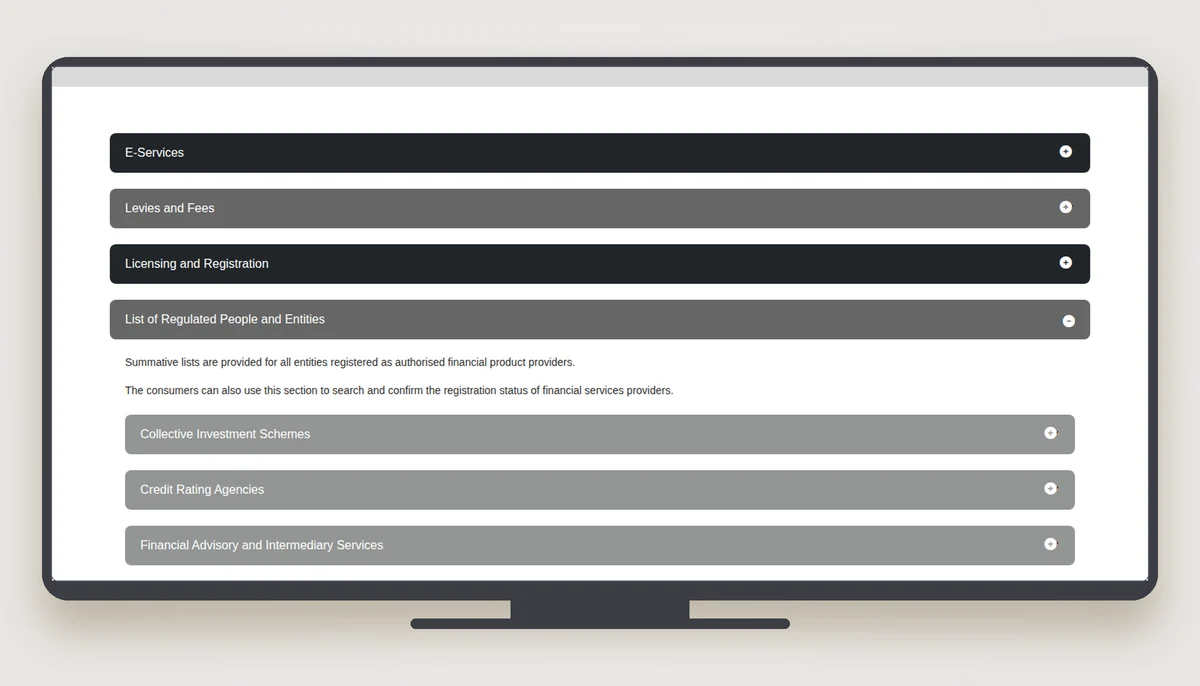
A platform that claims to be licensed should give you its FSP number and exact legal name. This page explains how to search the FSCA's register, what to read in the entry, and how to compare the details.
Find the FSP number and exact legal name
The first step is to find the FSP number and the exact legal name the platform shows. The FSP number is a number the FSCA gives to authorised financial services providers. The legal name is the name the platform is registered under, not its trading name. The platform may show the FSP number and legal name on its website, in its terms, or in its client agreement.
If the platform does not show an FSP number or a legal name, that is a warning sign. A licensed platform should make these details easy to find. The reader should ask the platform for the FSP number and the legal name before doing anything else.
Search the FSCA's register
The FSCA's register is a public online database of authorised financial services providers. The reader can search by FSP number, by legal name, or by trading name. The search should return a single entry if the details are correct. If the search returns no entry, the platform is not on the register.
If the search returns an entry, the reader should open it and read the details. The entry shows the legal name, the FSP number, the licence categories, the status, and the key individuals. The reader should compare each of these with what the platform claims.
Read the licence categories
The licence categories are the activities the provider is allowed to do. The FSCA's register lists categories such as advice, intermediary services, and over-the-counter derivative provider. The reader should check whether the platform's activities fall within the categories listed. A licence covers only listed categories.
For example, if the platform offers CFDs, the licence should include the over-the-counter derivative provider category. If the licence does not include that category, the platform is not authorised to offer CFDs. The reader should not assume that a licence to give advice covers trading.
Read the status and the key individuals
The status tells the reader whether the licence is active, suspended, withdrawn, or something else. The FSCA's register uses status words like authorised, withdrawn, and pending. The reader should check that the status is what the platform claims. If the platform says it is authorised but the register shows withdrawn, the platform's claim is false.
The key individuals are the people the FSCA has approved to manage the provider. The reader should compare the names with the names the platform shows. If the platform does not show any key individuals, or shows different names, the reader should ask why.
Compare the website and contact details
The reader should compare the website and contact details with the register entry. The register may show a website, an email address, and a phone number. The reader should check whether the platform's website and contact details match. If the platform uses a different website or a different email domain, the reader should ask why.
A clone can copy a real firm's name and FSP number but use a different website. The match must be on name, number and contact details together. If any of these do not match, the platform is not the licensed firm.
What a licence covers
A licence covers only the categories listed in the register. It does not cover activities outside those categories. A provider with a licence for advice cannot trade for you. A provider with a licence for over-the-counter derivatives cannot give advice unless that category is also listed. The reader should check that the platform's activities fall within the categories.
The licence also covers only the legal entity named in the register. A subsidiary or a different company with a similar name is not covered. The reader should check that the entity they are dealing with is the one named in the register.
The name on the register is the name you compare, not the trading name
A platform often markets itself under a short trading name that is different from the legal entity on the FSCA register. The register records the legal person that holds the licence, and that is the name a reader must search for. A trading name alone will not return an entry unless the FSCA has recorded it as an approved trading name.
The exact legal name appears on the FSP certificate and in the register entry. If a website only displays a brand or a logo and never the legal entity, that is a gap in the comparison. A reader cannot confirm whether the brand belongs to the licensed firm or to someone else entirely.
The order of operations is straightforward. First find the legal name on the platform's own disclosures, then search that name on the register. If the register shows a different status or no entry, the comparison has already failed before any other detail is checked.
A single FSP number can carry multiple licence categories
One FSP number does not mean one activity. An authorised financial services provider can hold several licence categories under the same number, each permitting a different type of financial service. The register lists these categories separately, and a platform may be licensed for one category but not for another.
A reader who assumes that any number equals any activity will be misled. A firm licensed for advice on long-term insurance is not necessarily licensed to deal in contracts for difference. The category descriptions on the register are specific, and the platform's own product must fall within one of those listed categories.
The practical consequence is that a check must match the product to the category, not just the name to the number. If a platform offers CFD trading but its register entry shows only short-term insurance categories, the licence does not cover what the platform is offering.
Key individuals are the people the FSCA has approved to manage the firm
The FSCA approves certain people within a licensed firm as key individuals. These are the people who manage or oversee the financial services, and their names appear on the register. A platform that claims to be licensed should be able to point to the key individuals listed for its FSP number.
The key individuals are not the same as the sales staff or the support team. They are the people accountable to the regulator for the firm's conduct. When a platform cannot name any key individual, or when the names it gives do not appear on the register, the reader is looking at a mismatch.
This is a failure mode that a simple name check misses. A platform may copy the FSP number and legal name of a licensed firm, but the key individuals are harder to imitate convincingly. Checking that the names on the platform's own disclosures match the register is a stronger test.
The status on the register is the regulator's current position, not the firm's claim
A platform may describe itself as 'FSCA regulated' or 'FSCA authorised' on its website, but the register shows the actual status the regulator has recorded. That status can be authorised, refused, withdrawn, or pending. A claim on a website is not the same as the status on the register.
The status matters because it tells the reader what the regulator has currently decided. A firm whose application is pending has not been authorised yet. A firm whose authorisation has been withdrawn is no longer licensed, even if its old FSP number still appears on old marketing material.
A common mistake is to see an FSP number on a website and assume the firm is currently authorised. The number may belong to a firm whose status has changed. The register is the only place where the current status is published, and that is the status the reader must use.
A licence check is a filter, not a guarantee of safety
Matching the name, number, categories, key individuals, and contact details to the register tells the reader that the platform is the same entity the FSCA has authorised. It does not tell the reader whether the platform will treat them fairly or whether their money is safe. The FSCA's authorisation is a regulatory status, not a recommendation.
A platform can be fully authorised and still fail its clients through poor conduct, high costs, or poor execution. The reader must still read the platform's own terms and conditions, understand the product, and decide whether the risk is acceptable. A licence check removes one class of risk, the risk of dealing with an unauthorised or cloned entity, but it does not remove all risk.
The editorial position of this site is that the reader decides. The register and the warnings are tools, not verdicts. A licence check is a necessary step before dealing with any platform, but it is not the only step, and it is not a promise that the platform is safe.
Why contact details are the last and hardest check
The register lists an address, a phone number and sometimes an email for the licensed entity. A platform that claims to be licensed should use the same details somewhere on its own site, usually in the footer or the contact page. When the numbers differ, the reader cannot tell which side is outdated without writing to the FSCA.
Contact details change more often than legal names or FSP numbers. A firm may move offices or change its phone provider and forget to update the register. That does not make the platform unauthorised, but it weakens the match between the site and the licence. A clone often copies the name and number but keeps its own contact details.
The reader should compare the website's contact details with the register, but not rely on that comparison alone. A phone number that rings through to a call centre in another country, or an email address on a free domain, is not proof of anything. It is one more piece of the picture, not the whole check.
Check facts
Read next
Common questions about FSCA checks
Where do I find the FSP number?
The FSP number should be on the platform's website, in its terms, or in its client agreement. If the platform does not show an FSP number, ask for it. A licensed platform should make the FSP number easy to find.
What if the search returns no entry?
If the search returns no entry, the platform is not on the FSCA's register. That means the platform is not authorised by the FSCA. The reader should be cautious before dealing with such a platform.
What are licence categories?
Licence categories are the activities the provider is allowed to do. The FSCA's register lists categories such as advice, intermediary services, and over-the-counter derivative provider. A licence covers only listed categories.
What are key individuals?
Key individuals are the people the FSCA has approved to manage the provider. The register shows their names. The reader should compare the names with the names the platform shows.
Can a licence cover a different name?
No. The licence covers only the legal entity named in the register. A subsidiary or a different company with a similar name is not covered. The reader should check that the entity they are dealing with is the one named.
A trading account is a decision, not a sign-up
Opening a CFD account means accepting leverage and the risk of losing the money you deposit. Before you open one, run the licence checks this site describes and read the client agreement and risk warning carefully.